 How-to
What Does Local Business Video Production Really Cost in 2026?
Last Updated: November 4, 2026
Quick Summary
Video production pricing is the total cost of turning a brief into a finished, usable video, built from four cost blocks: planning, filming, editing and rights. Each block scales with complexity, and the biggest driver is almost always time on set, so a half day with one videographer costs far less than two days with a crew of four.
- Ask every supplier to itemise their proposal under the same cost headings so quotes can be compared fairly.
- A promotional video should run 60 to 90 seconds for most local business use.
- AI video production removes filming days, crew, travel and equipment hire from the cost.
- Check who owns the finished video, where it can be used and for how long before you commit.
- Send the same written brief to every supplier so their proposals answer the same questions.
Table of Contents
- Why Video Production Pricing Confuses Local Businesses
- What Actually Drives Video Production Pricing
- Your Video Production Quote Checklist
- How Long Should a Promotional Video Be?
- Business Promotional Video Examples That Show Where the Money Goes
- AI Video Production for Small Businesses: Where the Savings Come From
- Usage Rights, Licensing and the Costs That Continue After Delivery
- Get a Concept Before You Commit a Budget
- Frequently Asked Questions
Why Video Production Pricing Confuses Local Businesses
Most local business owners approach video production pricing with the same question: why do two quotes for what sounds like the same job come back so far apart? At Apex Video Promotions, we see this confusion every week. The answer is that video production pricing is not a single product with a single rate. It is a bundle of decisions about time, people, equipment, and rights, and each decision moves the number.
A firm quote from one supplier may include a full crew and a two-day shoot. A cheaper quote may cover a single operator with a camera and no script. Both are called "a business video". That is where the fog starts.
Below, we break down what actually drives video production pricing for local businesses, how to read a quote line by line, and where the savings sit.
What Actually Drives Video Production Pricing
Video production pricing is the total cost of turning a brief into a finished, usable video, built from four cost blocks: planning, filming, editing, and rights. Each block scales with complexity, and the biggest driver is almost always time on set.
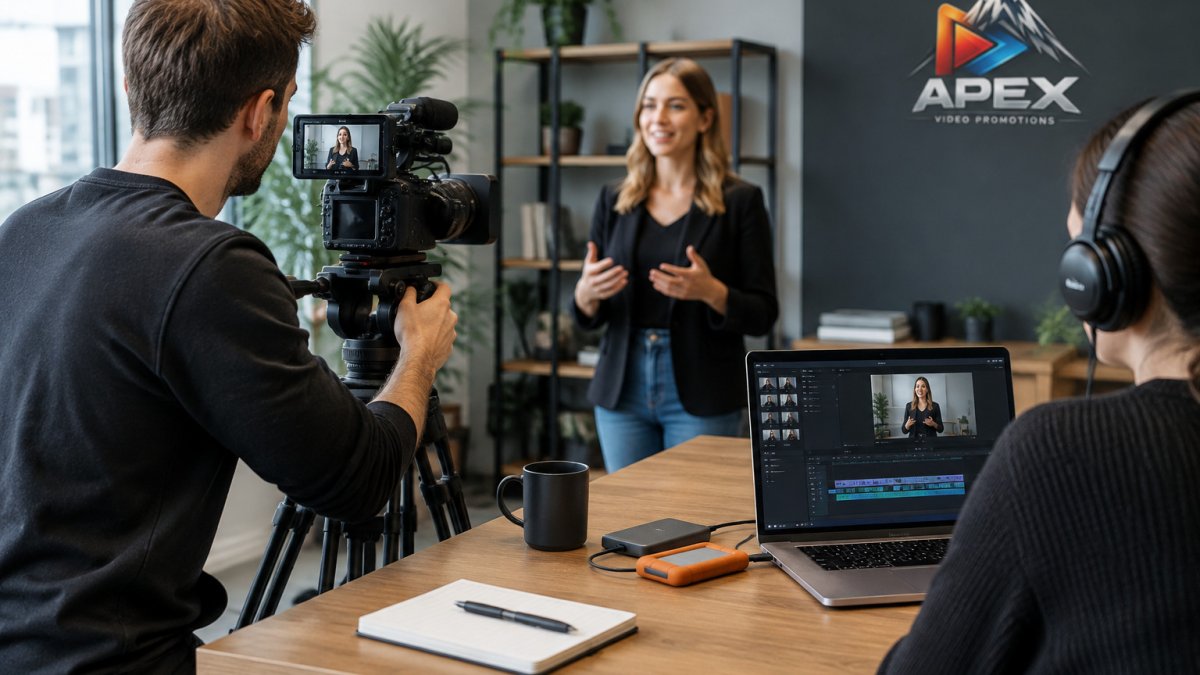
Filming days are the largest single line in most traditional quotes. A half-day with one videographer costs far less than two days with a crew of four. Add travel, equipment hire, and location fees and the gap widens fast.
Then editing takes over. Basic cutting is quick. Motion graphics, animation, and voice-over take longer.
If you want to see how those traditional figures stack up against an AI alternative, our affordable promotional video production UK comparison sets out the differences side by side.
Filming Days, Crew Size and Equipment
A shoot day is priced on people and kit. A single videographer with a camera and a light is the cheapest format. A crew of three or four with lighting, sound, and a second camera can multiply the day rate several times over.
Watch out: quotes that list a "day rate" without stating crew size or kit are impossible to compare. Always ask what is included in the day.
Editing, Motion Graphics and Revisions
Post production is where budgets quietly grow. Simple cuts and colour work are standard. Motion graphics, animation, and music licensing add cost.
Revisions matter too. Ask how many rounds are included and what happens after them. A quote with unlimited revisions is rare, and a quote with none is a trap.
Your Video Production Quote Checklist
A good video production quote checklist turns a vague estimate into a document you can compare. The problem is that most checklists stop at yes or no questions. To compare two quotes fairly, you need to see the same cost blocks broken out in the same way.
- Planning and pre production: scriptwriting, storyboarding, location scouting, casting, scheduling
- Filming days: number of days, crew size, roles, equipment list, whether a second camera is included
- Editing and post production: rough cut, fine cut, colour grade, sound mix, motion graphics, animation, voice over
- Music and stock footage: licensed or bought, term of licence, whether paid advertising use is included
- Travel and locations: mileage, congestion charges, parking, location hire fees, permits
- Deliverables: finished runtime, aspect ratios, number of social cutdowns, captions and subtitles
- Revisions: number of rounds included, hourly rate for additional rounds
- Usage rights: ownership, territory, duration, paid media allowance
- Payment schedule: deposit, milestone payments, final balance
- VAT: rate applied and whether the supplier is VAT registered

Run any two quotes for the same brief through the list above and the gap usually explains itself.
Watch out: a quote that lists a single total with no breakdown cannot be compared on a like for like basis, and the cheapest headline figure often becomes the most expensive once extras are added.
Before you request quotes, write a one-page brief covering the purpose of the video, where it will be shown, the target runtime, the deadline, the budget range, and who will appear on camera. Send the same brief to every supplier so their proposals answer the same questions.
How Long Should a Promotional Video Be?
A promotional video should run 60 to 90 seconds for most local business use, long enough to show the service and make the offer, short enough to hold attention. Website hero videos often work best at 30 to 60 seconds. Social clips can be shorter still.
Longer explainer videos suit complex services, but only when the viewer has a reason to keep watching. Length drives cost, because editing time grows with runtime. Decide the length before you brief anyone.
Here is the runtime guidance the article gives for common video formats.
| Video format | Suggested runtime | Note |
|---|---|---|
| Most local business promotional video | 60 to 90 seconds | Long enough to show the service and make the offer |
| Website hero video | 30 to 60 seconds | Often works best at this length |
| Social clips | Shorter still | Can be shorter than website video |
| Customer testimonial | Under 90 seconds | Edit keeps runtime under 90 seconds |
| Recruitment video | Two to three minutes | Longer edit across two locations |
| Explainer video | Longer | Suits complex services when viewers have reason to watch |
Business Promotional Video Examples That Show Where the Money Goes
The clearest way to judge spend is to look at finished work and the budget that produced it. Business promotional video examples show the difference between a simple talking head and a multi location shoot with graphics and voice over, and mapping realistic budgets to common local business goals makes the comparison concrete.
A website introduction video for a tradesperson, such as a locksmith or electrician, typically needs one filming day with a single operator, a short script, and a 60 to 90 second edit with captions. Pricing depends on travel and whether motion graphics are added, and current prices are available on request.
A customer testimonial for a salon or clinic usually needs a half day to film two or three customers, consent forms, and an edit that keeps the runtime under 90 seconds. Pricing depends on scheduling and the number of customers filmed. The main cost driver is scheduling and consent rather than equipment, and a second camera angle adds cost without adding much value for this format.
A recruitment video for a professional services firm often needs a full day across two locations, a crew of two, interviews with three or four staff, and a longer edit of two to three minutes. Pricing depends on the number of locations and interview subjects. Travel between locations and the number of interview subjects are the lines that move most.
A social media clip package for a restaurant or retailer might involve a half day shoot and five to eight short vertical edits. Pricing depends on the number of cutdowns required, as editing time for multiple cutdowns can be the largest line rather than the filming itself.
Our video marketing for businesses page shows the kinds of work we produce, so you can match the look to your goals. A locksmith, a salon, and a professional services firm all need different visuals, and a good producer prices the job around the outcome rather than a template.
AI Video Production for Small Businesses: Where the Savings Come From
AI video production for small businesses removes the cost blocks that dominate traditional quotes: no filming days, no crew, no travel, no equipment hire. The work moves into planning, AI generated visuals and voice, and human editing.
That does not mean the output is generic. Human creative direction, scriptwriting, and editing still shape the result. At Apex Video Promotions, we build concepts from your brief or website, often within 24 hours, with no cost until you approve the concept.
If you want the detail on how AI production is structured, our AI promotional video production page explains where the savings come from.
Usage Rights, Licensing and the Costs That Continue After Delivery
The quote is not always the whole cost. Usage rights, music licensing, and ongoing editing can add spend after delivery.
Ask who owns the finished video, where it can be used, and for how long. Music and stock footage are usually licensed, not bought, so check the terms.
Watch out: a cheap quote with limited usage rights can cost more later when you want to run the video in paid ads. Ask any supplier to confirm licensing, ownership, and ongoing costs in writing. Our frequently asked questions page answers the most common questions about licensing, ownership and ongoing costs.
Get a Concept Before You Commit a Budget
The safest way to control video production pricing is to see a concept before you commit money. A concept shows the direction, the style, and the script, so you can judge fit before the spend.
At Apex Video Promotions, we deliver a concept within 24 hours and charge nothing until you approve it. Our process removes filming days and crew costs, keeps human creative direction in the mix, and turns your brief into a finished video in around two weeks.
You get no shoot disruption, a cost effective route to professional video, and content built to convert website visitors into enquiries.
Get started with Apex Video Promotions and see your concept before you spend a penny.
Frequently Asked Questions
What should a video production quote include?
A proper quote should itemise pre-production (planning, scripting, storyboard), production (filming days, crew, equipment, location and travel), and post-production (editing, motion graphics, voice-over, music licensing, revisions). It should also state the number of finished deliverables, their formats and lengths, usage rights, and whether VAT is included. Ask for the revision rounds in writing. If a quote is a single lump sum with no breakdown, you cannot compare it against another supplier or spot where costs could be trimmed.
Is AI video production cheaper than traditional filming?
It usually is, because the biggest line items in traditional production are shoot days, crew and equipment hire, and AI production removes them entirely. There are no filming days to schedule, no camera operators to pay and no location costs. That said, pricing depends on the length, complexity and number of deliverables you need, so ask for an itemised quote rather than assuming. AI video production for small businesses tends to suit service firms that need regular content without a recurring production overhead.
How much should a small business spend on video marketing?
There is no single figure, because it depends on your goals, how many videos you need and how often you refresh them. A sensible approach is to set a budget against a specific outcome, such as improving website conversion or supporting a product launch, then ask suppliers what that budget delivers in finished videos and formats. Compare quotes on deliverables rather than headline price, and check what ongoing costs apply for licensing or updates before you commit.
Can a business make an effective promotional video without filming?
Yes. AI-powered production builds a video from your existing website, product information and marketing material, combined with human-led scripting, creative direction and editing. The result is a polished promotional video with no shoot day, no crew and no disruption to your premises. It suits service businesses especially well, since the video can focus on your offer, your process and your results rather than on filming a location. Ask to see concept work before committing to a full production.
Ready to see what your business video could look like? Book your discovery call and we will talk through your goals, your budget, and the right promotional video for your website.