
 ultimate-guide
Professional Video Marketing for Service Businesses
Table of Contents
- Why Professional Video Marketing for Service Businesses Matters
- Best Video Content Types for Service Providers
- Building a Video Marketing Strategy for the Service Industry
- Benefits of AI Video Production for Businesses
- How to Measure Video Marketing Success
- Tools and Platforms for Creating and Distributing Video
- Conclusion
- Frequently Asked Questions
Last Updated: September 17, 2026
Why Professional Video Marketing for Service Businesses Matters
Most service businesses sell something invisible. You cannot photograph a boiler repair, a legal consultation or an accountancy retainer the way a shop photographs a product on a shelf. That is exactly why professional video marketing for service businesses carries so much weight: it turns an abstract promise into something a potential customer can watch, understand and trust. At Apex Video Promotions, we see this shift every week, because the businesses coming to us are tired of describing what they do and want to show it instead.
Video marketing is the practice of using recorded or AI generated video content to promote a business, explain its services and move viewers towards a purchase decision. For service providers, it works because it compresses a sales conversation into 60 seconds.
The stakes are simple. A website visitor who cannot picture your service will compare you on price alone. A visitor who has watched your video already understands the value, so the conversation starts further along.
Best Video Content Types for Service Providers
The best video content types for service providers are explainer videos, customer testimonials, short social clips and website hero videos. Each one does a different job in the buying process, so most service businesses need two or three rather than one.
Explainer Videos That Simplify Complex Services
An explainer video breaks a complicated service into a short, visual sequence. This matters most for trades, professional services and technical providers, where the customer often does not know what the work involves or why it costs what it costs. A well built explainer walks through the problem, the process and the outcome in under two minutes.
The most common mistake here is trying to cover everything. An explainer that lists every service you offer explains nothing. Pick the single service that generates the most revenue and build the video around that.
Customer Testimonials and Trust Builders
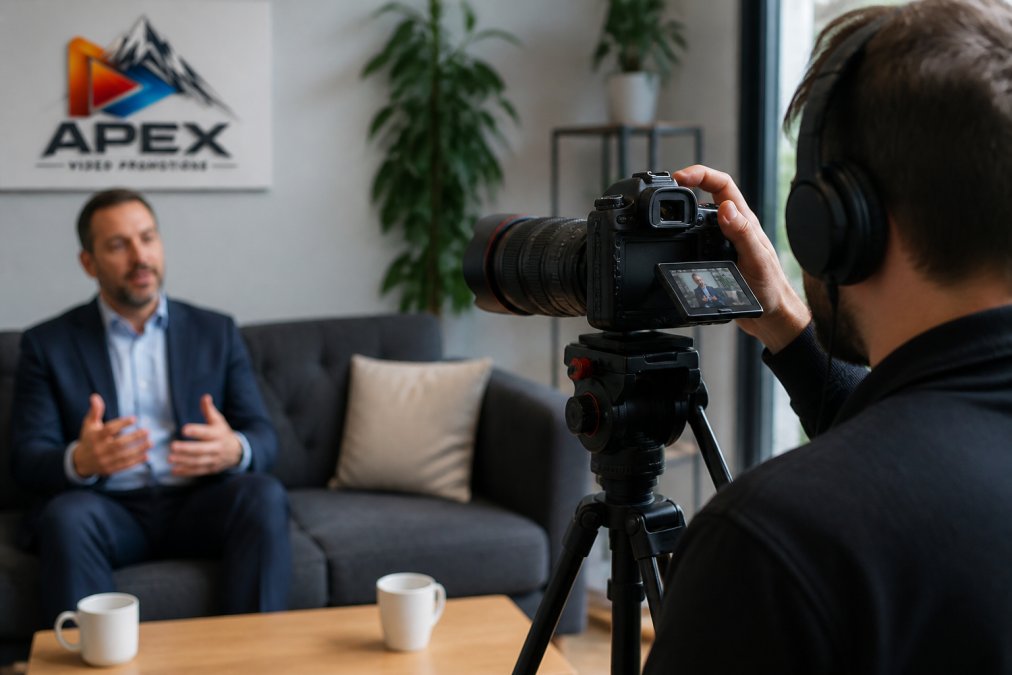
Testimonials do the persuading that your own marketing copy cannot. A customer describing a problem you solved reads as evidence, not a claim. Keep them short, film them in the customer's own environment where possible, and ask them to name the specific outcome rather than praising you in general terms.
For service businesses without willing customers on camera, an AI generated testimonial style video or a written case study read aloud over visuals can fill the gap, though real faces always convert better.
Building a Video Marketing Strategy for the Service Industry
A video marketing strategy for the service industry starts with one clear message, one audience and one platform, then expands only once that combination produces results. Businesses that try to launch on five channels at once usually finish with five unfinished projects.
Step 1: Define Your Audience and Core Message
Write down who you are talking to and what they are worried about before you write a single line of script. A landlord with a burst pipe and a facilities manager planning a refurbishment need completely different videos, even if you serve both.
Then commit to one core message. If your video could be summarised as "we are reliable, affordable and experienced", you have not chosen a message. Choose the one claim you can prove and build around it.
Step 2: Choose Your Platforms and Distribution Plan
Match the platform to where your customers already spend time and to the length your message needs. A single long video can be cut into several shorter clips, which is far more efficient than producing separate content for each channel.
| Platform | Ideal Length | Best For | Effort to Maintain |
|---|---|---|---|
| Website hero video | 60-90 seconds | Converting visitors | Low |
| Social media clips | 15-45 seconds | Awareness and reach | High |
| Email and proposals | 60-120 seconds | Nurturing warm leads | Low |
| Paid ads | 15-30 seconds | Direct response | Medium |
Benefits of AI Video Production for Businesses
The benefits of AI video production for businesses come down to three things: no filming day, a much shorter timeline and a cost that does not require a board approval. Traditional production asks you to close the office, gather staff and wait weeks for a crew. AI production asks for a brief.

Apex Video Promotions combines AI generated video, imagery and voice with human led creative direction, scriptwriting and editing. Concepts are typically developed within 24 hours, and there is no cost until you approve the concept. Full turnaround usually lands around two weeks, which fits comfortably inside most campaign deadlines.
How to Measure Video Marketing Success
How to measure video marketing success depends on what the video is for. Awareness videos are judged on views and watch time; conversion videos are judged on enquiries, bookings and sales. Measuring the wrong metric makes a working video look like a failure.
Set the goal before production starts, then track it consistently:
- Watch time and completion rate for explainer content, showing whether the message holds attention
- Click through rate on the call to action, showing whether viewers want the next step
- Enquiry and booking volume from pages that carry video versus pages that do not
- Cost per enquiry compared with your other marketing channels
A common mistake is judging every video by view count. A testimonial watched by 40 qualified prospects can outperform a social clip watched by 4,000 people who will never buy.
Tools and Platforms for Creating and Distributing Video
Distribution tools matter as much as production. A video that sits on a hard drive converts nobody, so pick a hosting platform that gives you analytics and a player you control.
Google's guidance on video SEO and indexing is worth reading before you publish, because it explains how video content is discovered in search results.
For hosting, Wistia provides detailed viewer analytics and lead capture forms, with a free tier available. Loom suits service providers sending personalised video updates to clients, with straightforward recording and sharing. For production itself, subscription creative services offer ongoing editing capacity, while full service agencies handle end to end delivery. Apex Video Promotions sits in a different category: AI powered production with human creative direction, aimed at businesses that need a professional result without a filming schedule. If you would rather start from what you already have, Turn Your Website Content Into High Converting Videos is one route, while AI Video Marketing for UK Businesses covers the broader campaign side.
Conclusion
The hardest part of video marketing for a service business is not the technology, it is finding the time and the budget to produce something that actually reflects how good you are. Most businesses put it off for years and keep losing enquiries to competitors who simply explain themselves better.
Frequently Asked Questions
Why is video marketing essential for service-based businesses?
Service businesses sell trust and expertise, which are hard to convey through text alone. Video lets potential clients see how you work, hear your tone, and understand your process before they commit. It also keeps visitors on your website longer and gives them a reason to choose you over a competitor who only has written content. For trades, consultancies, and professional services, video shortens the gap between interest and enquiry.
How can AI technology improve video production for small businesses?
AI removes the biggest barriers: cost, time, and logistics. Instead of booking a film crew and waiting weeks, you can supply your website content or a brief and receive a concept quickly. AI handles voice, imagery, and editing, while human creative direction ensures the result matches your brand. This makes professional video marketing for service businesses accessible to smaller teams with limited budgets and tight deadlines.
What types of video content work best for service providers?
Short explainer videos that clarify what you do and who you help tend to perform well. Customer testimonials build credibility, especially for trades and professional services. Behind the scenes clips show your process and put a face to the business. For paid ads, a 15 to 30 second problem and solution format works on social media. The best video content types for service providers are the ones that answer a specific question your ideal client is already asking.
How do you measure the ROI of video marketing campaigns?
Start with engagement metrics: view duration, click through rate, and social shares. Then track conversions. Use UTM tags on video links and set up goals in your analytics platform to see which videos lead to enquiries or sales. For website videos, compare conversion rates on pages with and without video. How to measure video marketing success comes down to connecting views to actions, not just counting plays.
Do I need a professional film crew for high-quality video marketing?
No. Traditional film crews add cost and scheduling complexity that many service businesses do not need. AI powered production with human creative oversight can deliver polished promotional videos without filming days. You provide your brief, website, or existing marketing material, and the production team handles scripting, visuals, and editing. This approach suits locksmiths, plumbers, consultants, and other service providers who need professional results without the overhead.
How can video content help build trust with potential clients?
Video lets people see and hear you before they make contact. That familiarity reduces perceived risk, especially for services where the client is inviting someone into their home or relying on expert advice. Testimonials from real customers, a clear explanation of your process, and a consistent brand presence across your website and social media all reinforce credibility. Trust builds faster when prospects can watch how you communicate and what you stand for.