 how-to
How to Make Viral Marketing Content Using AI in 2026
Table of Contents
- What You'll Need Before You Start
- Step 1: Find a Trend Worth Riding
- Step 2: How to Write Viral Video Scripts With AI
- Step 3: Pick From the Best AI Video Generation Tools for Business
- Step 4: AI Video vs Traditional Production: What Changes
- Step 5: Publish, Test and Improve Your Viral Marketing Content
- Common Mistakes That Kill Reach
- Conclusion: Build a Repeatable System, Not a One-Hit Wonder
- Frequently Asked Questions
Last Updated: 4 October 2026
What You'll Need Before You Start
You do not need a camera, a studio or a film crew to make viral marketing content using AI. You need a clear offer, a target audience and a system that turns trends into finished videos fast.
At Apex Video Promotions, we build promotional videos for businesses that want attention without a filming day. The same principles apply whether you produce in house or work with a partner.
Before you start, gather these basics:
- A one line description of what you sell and who buys it
- Two or three customer questions you hear every week
- Access to your social accounts and website analytics
- A folder for raw clips, scripts and captions
- One AI tool for scripting and one for video assembly
That is the whole kit. Everything else is process.
Step 1: Find a Trend Worth Riding
Trends fade fast, so speed matters more than polish. A video published while a topic is climbing will outperform a better video published two weeks late.
Start by watching what your audience already shares. Check platform trending pages, search suggestions and comment sections on competitor posts. Look for questions that keep repeating.
Then filter each trend with three tests:
- Does it connect to what you sell?
- Can you add a useful angle in under 60 seconds?
- Will it still make sense in a month?
If a trend fails any test, skip it. Chasing every spike wastes production time and confuses your audience about what you do.
A common mistake is jumping on trends that have nothing to do with your service. Reach without relevance brings views, not customers.
Step 2: How to Write Viral Video Scripts With AI
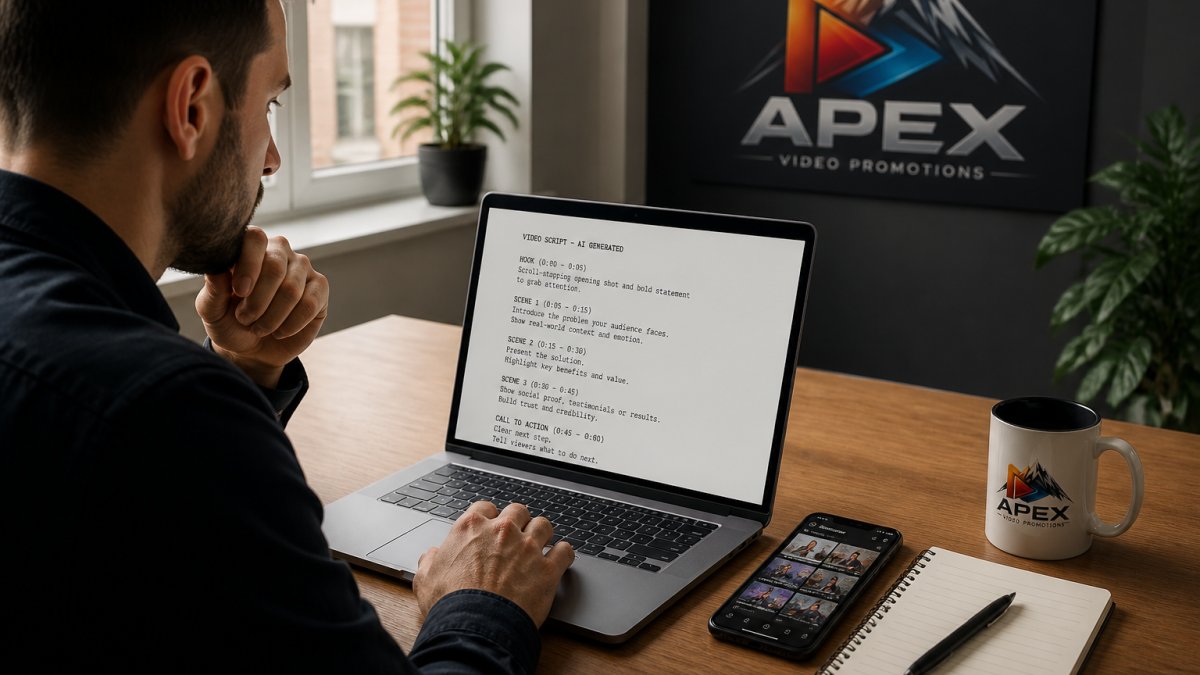
A strong viral video script opens with a hook in the first three seconds, states one idea, and ends with a clear next step. AI can draft that structure in minutes, but the angle has to come from you.
Feed your tool a tight brief. Include the audience, the platform, the length and the single point you want to land. Vague prompts produce generic scripts that sound like everyone else.
Use this template:
Hook: [Bold claim or question about the customer's problem] Problem: [One sentence on what goes wrong] Turn: [How it gets fixed] Proof: [A result, a detail or a demonstration] Call to action: [What to do next]
Then edit hard. Cut every line that does not move the viewer forward. Read the script aloud and delete anything you would not say in conversation.
For more on turning website copy into scripts, see our guide to AI promotional video production.
Step 3: Pick From the Best AI Video Generation Tools for Business
The best AI video generation tools for business fall into two groups: those that create clips, voice and music, and those that help you edit and caption fast. Most teams need one from each group.
Choose based on output volume, not feature lists. A tool you use weekly beats a tool with every feature that you open twice.
Tools That Generate Clips, Voice and Music
These tools turn text, images or existing footage into finished scenes. They handle voiceover, background music and visual assembly.
Look for:
- Consistent branding across clips
- Natural sounding voice options
- Licence terms that cover commercial use
- Export formats that match your platforms
Test with one short video before committing. Check how the voice sounds and whether the visuals match your tone.
Tools That Help You Edit and Caption Fast
Editing tools matter more than generation tools for reach. Most viewers watch without sound, so captions drive completion rates.
Priorities here:
- Automatic captions you can correct quickly
- Simple trimming and reordering
- Vertical and square exports
- Templates you can reuse
A repeatable template saves hours every week. Build one, then vary the script and visuals.
| Tool Type | What It Does | Best For | Watch Out For |
|---|---|---|---|
| Clip and voice generators | Turn text or images into scenes with narration | Teams with no footage | Robotic voice if untuned |
| Editing and caption tools | Trim, caption and resize footage | Anyone publishing weekly | Poor auto captions on accents |
| Template libraries | Reusable layouts and styles | Small teams scaling output | Sameness across videos |
Step 4: AI Video vs Traditional Production: What Changes
The difference between AI video and traditional production comes down to time, cost and control. Traditional shoots need planning, crew, locations and editing passes. AI production removes the filming day entirely.
Here is what actually changes:
- Speed: concepts can be developed in a day rather than weeks
- Cost: no crew, equipment hire or studio time
- Flexibility: changes to script or visuals are edits, not reshoots
- Consistency: the same style across every video
What does not change is the need for a clear message. A weak script fails in any format.
Where traditional production still wins is human performance. If your brand depends on a founder speaking to camera or real customer footage, film those pieces and use AI for everything around them.
For a full breakdown of how we approach this, see our page on AI video marketing for businesses.
Step 5: Publish, Test and Improve Your Viral Marketing Content
Publishing is the start of the process, not the end. Viral marketing content improves through testing, not through one perfect upload.
Post at consistent times, then track three numbers:
- Hook rate: how many viewers watch past three seconds
- Completion rate: how many reach the end
- Click rate: how many take the next step
Change one variable per test. Swap the opening line, then the thumbnail, then the call to action. Keep a simple log of what you changed and what happened.
Repurpose winners. A video that performs well on one platform can be cut down, reworded and posted elsewhere. Most teams underuse their best clips.
Common Mistakes That Kill Reach
The biggest reach killer is a slow opening. If the first three seconds do not earn attention, nothing else matters.
Other frequent errors:
- Posting the same video everywhere without resizing
- Using AI voiceover with no human review
- Chasing trends unrelated to your service
- Skipping captions on sound off platforms
- Publishing once and never testing again
Each of these is fixable in a single production cycle.
Conclusion: Build a Repeatable System, Not a One-Hit Wonder
One viral video is luck. A system that produces strong videos every week is a business asset. The steps above work because they remove the slow parts: no filming days, no waiting on crews, no guesswork about what to post.
Apex Video Promotions combines AI generated video, imagery and voice with human led scripting and editing. We deliver a concept within 24 hours, there is no cost until you approve it, and final turnaround is around two weeks. You can start from your website, product details or existing marketing material.
Get started with Apex Video Promotions and turn your next campaign into video that earns attention and converts visitors.
Frequently Asked Questions
Can AI-generated content really go viral on social media?
Yes, but AI is the production tool, not the reason people share. Videos go viral when they trigger a strong emotion, answer a common question fast, or show something unexpected. AI helps you produce those videos quickly and cheaply, so you can test more ideas. The strategy, hook and audience fit still decide whether a clip spreads. Treat AI as a way to increase your number of attempts, not a guarantee of reach.
How do you balance AI automation with human creativity in marketing?
Use AI for the repetitive work: drafting scripts, generating b-roll, cutting clips and adding captions. Keep humans on the decisions that shape the message: choosing the angle, approving the hook, checking tone and making sure the claims are accurate. A practical split is to let AI produce three or four script variations, then have a person rewrite the opening line and the call to action. That combination usually performs better than either fully automated or fully manual production.
Are there copyright considerations for AI-generated marketing assets?
Yes. Under UK law, copyright protects original works, and the status of purely AI-generated material is still developing. In practice, keep records of the tools and prompts you use, avoid uploading third-party footage or music you do not have rights to, and check each platform's terms for commercial use. If you use a production partner, ask who owns the final files. Getting this clear before you publish protects you if a clip performs well and attracts attention.
How does AI video production differ from traditional filming methods?
Traditional production needs a crew, a location, filming days and a schedule that can run for weeks. AI video production replaces the shoot with generated visuals, synthetic voice and automated editing, so the timeline is measured in days rather than weeks and there is no disruption to your site or staff. The trade-off is that AI works best for product, service and explainer content, while complex human performance still suits a camera. Many businesses use AI for volume and reserve filming for flagship pieces.